Trading Stories
Shehan Karunatilaka, winner of the Booker Prize, has been commissioned by Powerhouse to write about objects in the Powerhouse Collection. In this work he shows how the business world embraces storytelling as much as novelists do.
Trading Stories
Pick a few objects and write about them, they said. Seemed simple enough. Was anything but. When browsing a museum as extensive and as eccentric as the Powerhouse Collection, shortlisting a handful from a half million is a very particular challenge. You begin by clicking anything that catches your eye (which is most of everything), curate your own warehouse of the strange and the enchanting, and then get lost in labyrinths of story, history and curiosity.
Then, after a while, a few objects begin speaking to you. And you listen as carefully as you can and go in for a closer look. The curiosities are whispering across time and sharing variations on a familiar tale, one that has recently colonised your thoughts.
I ended up with four objects, each from a different century, made in a different country. A coin, an elephant, a calculator, some sunglasses. One made of gold, the others of metal, graphite and plastic. These treasures share neither design nor function, neither texture nor colour, but to me, they tell similar stories, articulating ideas on commerce and invention, tales I am only just beginning to grasp.
Each would’ve been a minor innovation of its day, reflecting an economic paradigm shift of its time: the minting of currency, the automating of finance, the wearing of technology. Two of the objects are innovations of science, two are works of artistry. Each reflect the changing face of commerce over the centuries and prompt reflections on business, fiction, objects and obsolescence.
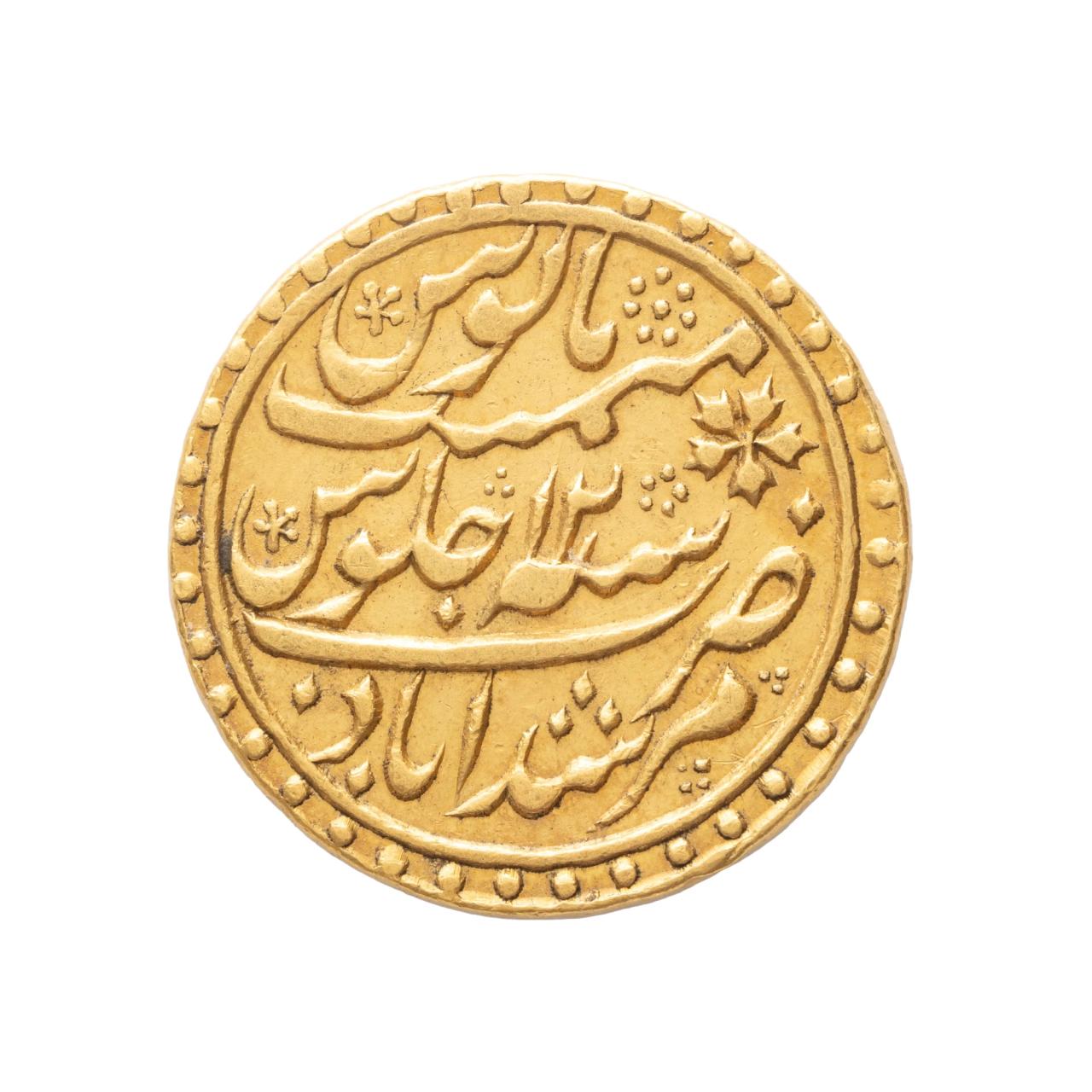
Let’s begin with Object No. 2009/21/1-77. A gold 1 Mohur coin from the British East India Company, minted in Calcutta or Murshidabad in 1774 in the name of Shah Alam II, who signed over tax collecting rights of Bengal, Bihar and Orissa to the East India Company nine years earlier, subcontracting the state’s power to a marauding corporation. The coin’s cursive inscription, curved symbols and dazzling sheen remind me of the Sri Lankan panchayudhaya, a traditional pendant made for young children to ward off the evil eye.
In 2022, Sri Lanka suffered that most abstract of catastrophes, an economic collapse, which brought people to the streets, expelled a president, and tanked, among other things, our currency. Our paradise has remained a permanent member of what was once the Third World and is now the Global South. All this, despite being blessed with fertile soil, bright people and a strategic location at the centre of the world map. Our underachieving economy no longer had a war to hold us back, and yet in 2022, Sri Lanka collapsed publicly and spectacularly.
Our economic apocalypse was nothing like Mad Max. For starters, there was no petrol, just endless queues coiling around the sheds. Then came the power cuts, and then the escalating prices. Then the people stormed the buildings and the leaders resigned. How did all this happen? A good question with plenty of answers depending on who you ask.
As a writer of fictions, economic systems and the vagaries of commerce have never interested me, until they suddenly became the main story. To understand Sri Lanka’s latest calamity, I read business sections and chatted to men and women who wore suits for a living. The more I understood about inflation, taxation, trade and finance, the more it appeared that the business world embraces storytelling as much as novelists do.
I learned about stock prices, bond indices, insurance policies and the basic notion of a company as a legal entity. All invented stories based on theory, maths, human behaviour and other intangibles. Stories that people made up, shared, quantified, accepted and now rarely questioned. The world of economics appeared as nebulous and as abstract as the fantasy worlds that writers dreamed up. By the time I got to the speculative fictions of derivatives, futures, credit swaps, foreign debts, hedge funds and offshore tax havens, my head began to throb. Each expert had a different narrative to explain the same catastrophe.
The invention of currency was one of our first fictions. Why did our collective imaginations gravitate towards shiny things, and designate gold and silver and gems as objects of value? And why have we now transferred this fiction to paper, plastic and encrypted numbers – objects conspicuously bereft of sheen? This gold Mohur coin is undoubtedly prettier than a ledger of crypto and was used to facilitate tax collection on behalf of an aggressive colonial power, a corporate raider armed with treaties signed at gunpoint. British Bengal of the 1770s was a place of wars and famines, where a multinational company, that other ingenious fiction, ruled Bengal through tax ledger and sword, through currency and conquest.
Many contemporary history podcasts wax indignant about the British and Dutch East India companies, their brazen plunder of half the world under the guise of commerce, and the parallels with today’s multinational corporate behemoths.
The multinational corporation is the original artificial intelligence, an entity which transcends the replaceable humans who create and helm it. It can command more wealth than a small nation, and cross continents nimbly through capital, credit and brand equity. It wasn’t the British who first colonised Bengal, but the East India Company, a few hundred clerks, who ran a continent from an office in London, who commanded armies of mercenaries, took over the world’s commercial centre and then sold it to their Queen.
Today’s corporations dwarf the wealth of most nations. The Apples, Microsofts, Amazons, ExxonMobils and Teslas have more influence over nations, peoples, economies and policies than governments do. Though, as this glittering coin and its story attest, this phenomenon is hardly a recent one.
Object No. 2010/1/235: the Monroe L160-X accounting machine does not glitter. Delightfully mechanical and adorned with circular buttons, wind-up cranks, triangular pegs and square holes, it looks like a typewriter that weaves its fiction through numbers and cogs. It is not my first encounter with this 1950 desktop calculator. Years ago, writing a coffee-table book for a bank, I saw one in the company archives, with its office nickname ‘Marilyn’ scrawled above its brand name, proving that Ceylon offices, even in the 1950s, had as high a joker-to-worker ratio as they do today.
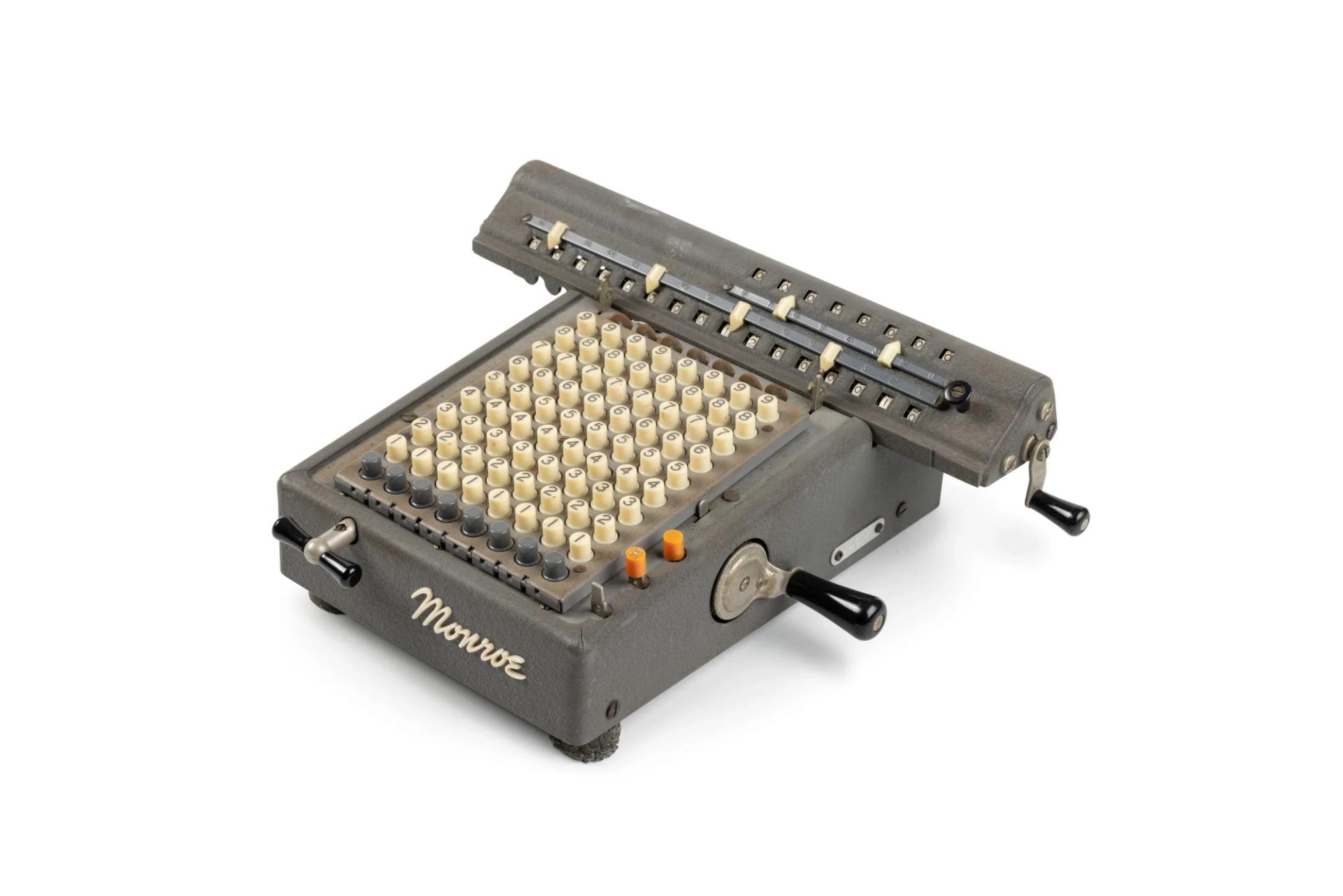
Capable of multiplying and dividing without a pencil, and adding and subtracting vast sums at once, the Monroe L160-X must have appeared to banking staff of the 1950s as touchscreen tablets did to audiences in the 2000s. Accountants may not be widely regarded for their imagination or invention, but that doesn’t mean they aren’t creative. Peruse any modern annual report and you will see fictions and fantasies woven from numbers crunched, massaged and processed on machines, the great-great-grandchildren of this metallic cash register.
Having written both fantastical fiction and fact-based journalism, and having tightroped the line between the two during my advertising career, it is a curious admiration I feel for the financial writers of any annual report. While cooking the figures and fabricating the numbers are understandably illegal, there is still tightrope-walking to be performed by economists and accountants who interpret the figures, conjure up narratives to explain them, and find positives to mollify shareholders with.
Today all ledgers are digitised, all calculations are automised, and our wealth is measured not in gold or coins but in numbers on screens. Machines like the Monroe allowed abstract financial ideas such as options, futures and derivatives to be applied at scale, and allowed the fictions of wealth, growth and prosperity to be passed off as unquestionable truth. Every application and algorithm that powers the machine in your pocket might trace its ancestry here.
The first Monroe mechanical calculator was produced in 1912, which means this version is the equivalent of an iPhone 15 Pro. Every antiquated contraption was once state-of-the-art. It used to take decades for an innovation to become a museum piece. These days, our gadgets grow obsolete in months, not years.
The Ray-Ban Stories smart glasses (Object No. 2023/6/1) is a gadget that is either ahead of its time or behind the wrong curve, depending which tech articles you read. It’s a collaboration between corporate giants: Meta, the technology colossus that owns Facebook, Instagram and WhatsApp, and EssilorLuxottica, the eyewear conglomerate that markets every sunglass brand you could care to name.

Designed to liberate humanity from hunching over screens, smart glasses aim to take the screen from your palm and place it before your eyes. Now you can film the world without holding up your phone, receive music without plugging in headphones, and decorate your observed reality with augmented or virtual layers.
The idea of smart glasses has been around for over a decade but hasn’t quite achieved the anticipated ubiquity due to issues of privacy and creepiness. How would humans interact with a stranger whose face was a camera? What would having a permanent screen before your eyes do to your mind?
The Ray-Ban Stories smart glasses represent several paradigm shifts, each as significant as the creation of currency, the invention of the multinational company, the automation of business and the gamification of investment. As this century unfolds, will the line between online and offline continue to blur? When will the virtual replace the actual? How do you get to choose the filter through which you view the world?
Object No. 6189, a graphite sculpture of a Ceylon elephant, may at first seem anomalous to my theme here. It is certainly the odd one out in my mini collection, an ornamental work of artistry, seemingly unrelated to the fictions of commerce, the paradigms of economics and the spread of technology.
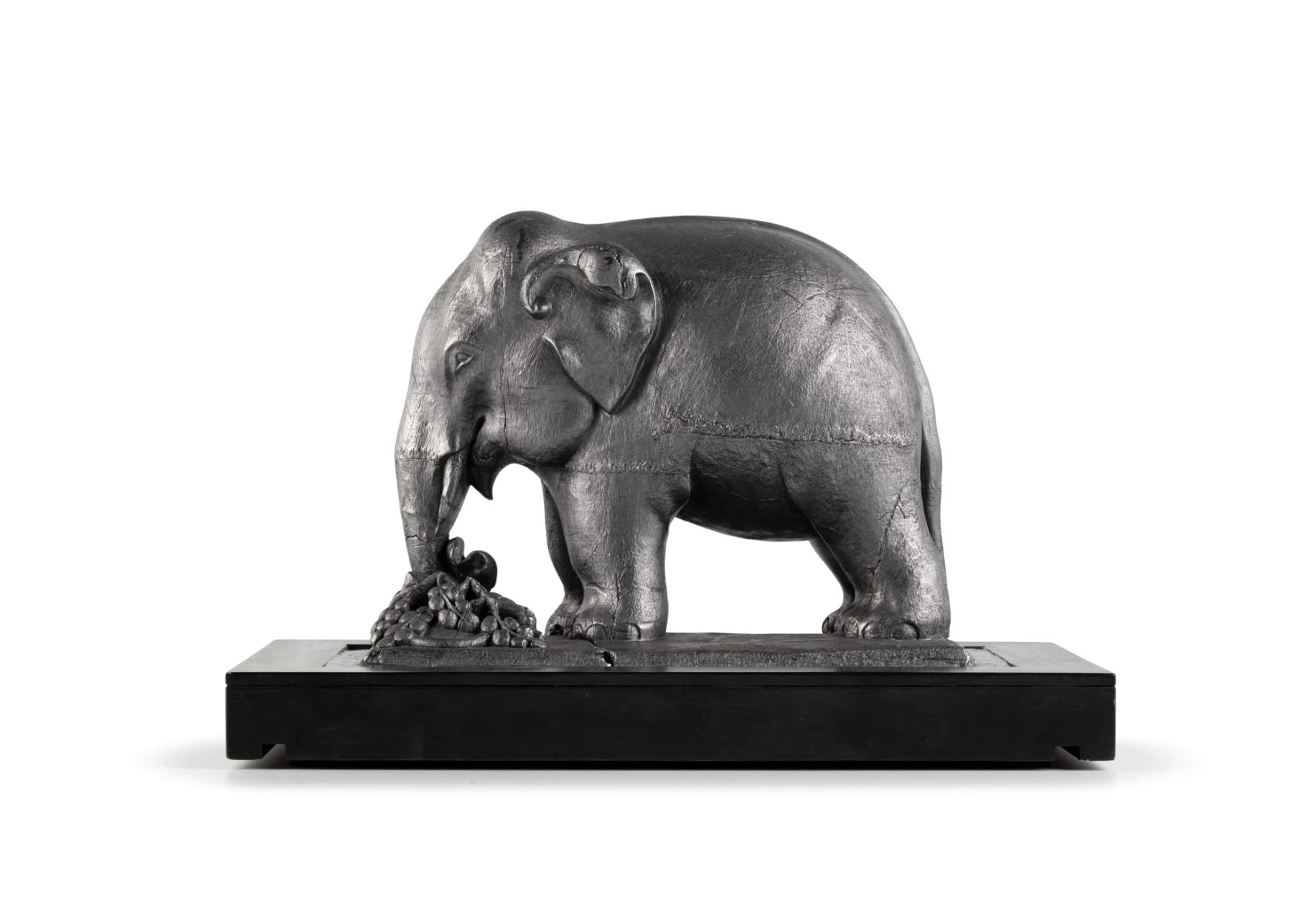
A block of graphite or plumbago or pencil lead crafted by an artisan from Colombo’s Cinnamon Gardens about 1875 to resemble a tubby elephant munching on stylised areca nut leaves, it was displayed at the Melbourne International Exhibition in 1880 and survived the great fire of 1882 that destroyed Sydney’s Garden Palace.
One of the oldest acquisitions in the Powerhouse Collection, this striking and evocative piece slots conveniently into the century between the Coin and the Calculator, though it does contain its own fictions. A lion may feature on Sri Lanka’s flag, but it is the elephant who occupies our forests and imaginations and has served Ceylon as muse, symbol, brand and reluctant mascot. Elephants have also appeared on many Ceylonese coins, as Object No. 2009/21/1–70 (an 1815 copper alloy coin) from the Powerhouse Collection attests. Our graphite elephant seems more inspired by graphic representations like these than by naturalism.
Festooned in costume and lights for July’s iconic Kandy Perahera or parade, elephants are presented to eager tourists in the wild, in orphanages and even on urban streets. The island’s pachyderm population hovered close to 20,000 when this graphite was sculptured into elephant in the 1800s. Today the number is below 7000. While no longer hunted for sport, as they once were by our colonial masters, today hundreds fall prey to the human-elephant conflict caused by habitat loss, drought, poverty and ignorance. At recent Peraheras, triggered by the noise, the lights and the continued mistreatment, costumed elephants have broken their chains and run amok into crowds, prompting discussions on animal cruelty and on whether a centuries-old cultural tradition contravenes millennia-old Buddhist wisdom of compassion to all living beings.
What most caught my attention was not the animal or the design, but the materials used. Graphite is one of the many resources Sri Lanka is said to be blessed with, along with gems, limestone, phosphates and spices, and the perfect soil for coconut, rubber and tea. Just like with our cinnamon and our sapphires, there are websites claiming Ceylon graphite to be the ‘best in the world’. Yet this industry, like many before and since, thrived in the 1800s, where it made more than 20% of colonial Ceylon’s foreign earnings, before declining between last century’s two great wars. Attempts to revive it a generation ago came to nought and graphite remains one of Sri Lanka’s many squandered economic opportunities.
It is strange to look at Object No. 6189, a loving render of a stately creature, and project our nation’s failures onto it. We’re told our country is blessed with natural resources, resourceful people and abundant potential. And then we watch as our economies collapse, our wealth is pocketed and our nation propped up by loans. Since gaining independence in 1948, Ceylon has filled itself with white elephants, sold colourful replicas to the tourists and watched while the real ones in the wild plod towards extinction.
Perhaps, yet again, it is the fiction that has let us down here, the stories we tell ourselves do not quite square with reality. Sri Lanka will not progress by electing the criminally incompetent, by neglecting its potential and by squandering its chances. We can tell ourselves we are blessed, and that things will turn around. We can blame our misfortunes on bad luck or ancient curses, on foreign conspiracies or minorities. We can choose stories that liberate us, or ones that hold us back.
Reflecting on the Coin, the Calculator and the Sunglasses, we see past the fictions of commerce and progress and begin to appreciate the ingenuity of it all. Ideas and stories can create value, speed progress and fuel innovation. But gazing on the graphite elephant, we see only lost opportunities and wonder if we could treat our living creatures with the reverence we reserve for our symbols.
Gazing at objects discarded by history and commerce, we appreciate invention and how ephemeral it can all be. All technology, no matter how dazzling, will be replaced, just as all of us will be. But at least works of art like Object No. 6189, the graphite elephant of no practical use, are less likely to be rendered obsolete.
Author
Shehan Karunatilaka won the Booker Prize in 2022 for his second novel The Seven Moons of Maali Almeida. He is considered one of Sri Lanka’s foremost authors. In addition to his novels, he has written rock songs, screenplays and travel stories. He emerged onto the global literary stage in 2012, when he won the Commonwealth Book Prize and the DSC Prize for South Asian Literature for his debut novel Chinaman. The book was declared the second-best cricket book of all time by Wisden. Born in Galle, Sri Lanka, in 1975, Karunatilaka grew up in Colombo, studied in New Zealand and has lived and worked in London, Amsterdam and Singapore. He currently lives in Sri Lanka. His songs, scripts and stories have been published in Rolling Stone, GQ and National Geographic. He has worked as an advertising copywriter and played guitar in a band called Independent Square.
Writing Objects
Writing Objects is a new series of writing engaging with the Powerhouse Collection, opening it up to new audiences and communities. Writers from Australia and around the world share their response to objects.
Bringing scientific, historic and personal perspectives, these stories highlight the museum’s newly digitised collection of close to 500,000 objects and offer new ways to navigate the applied arts and sciences.
The Powerhouse digitisation project is one of the largest being undertaken internationally and will result in new levels of community access to the museum’s extraordinary collections for local, national and international audiences.