Folding Time

Touch a tree and know it’s seen the past; dip your toes in a river and see the future; walk on earth and have a memory that is not your own; Country and time are interconnected. In Folding Time, artists and architects Sarah Lynn Rees, Matte McConell and r e a discuss how they collaborate, learn from and teach with Country.
‘Every project we do is reshaping Country in some way and there’s a huge responsibility in that.’
Sarah Lynn Rees I’ll start this by acknowledging Gadigal Country and to all of your ancestors in the room: past — and in the context of Folding Time — future ancestors and what that might mean for us over the course of the day.
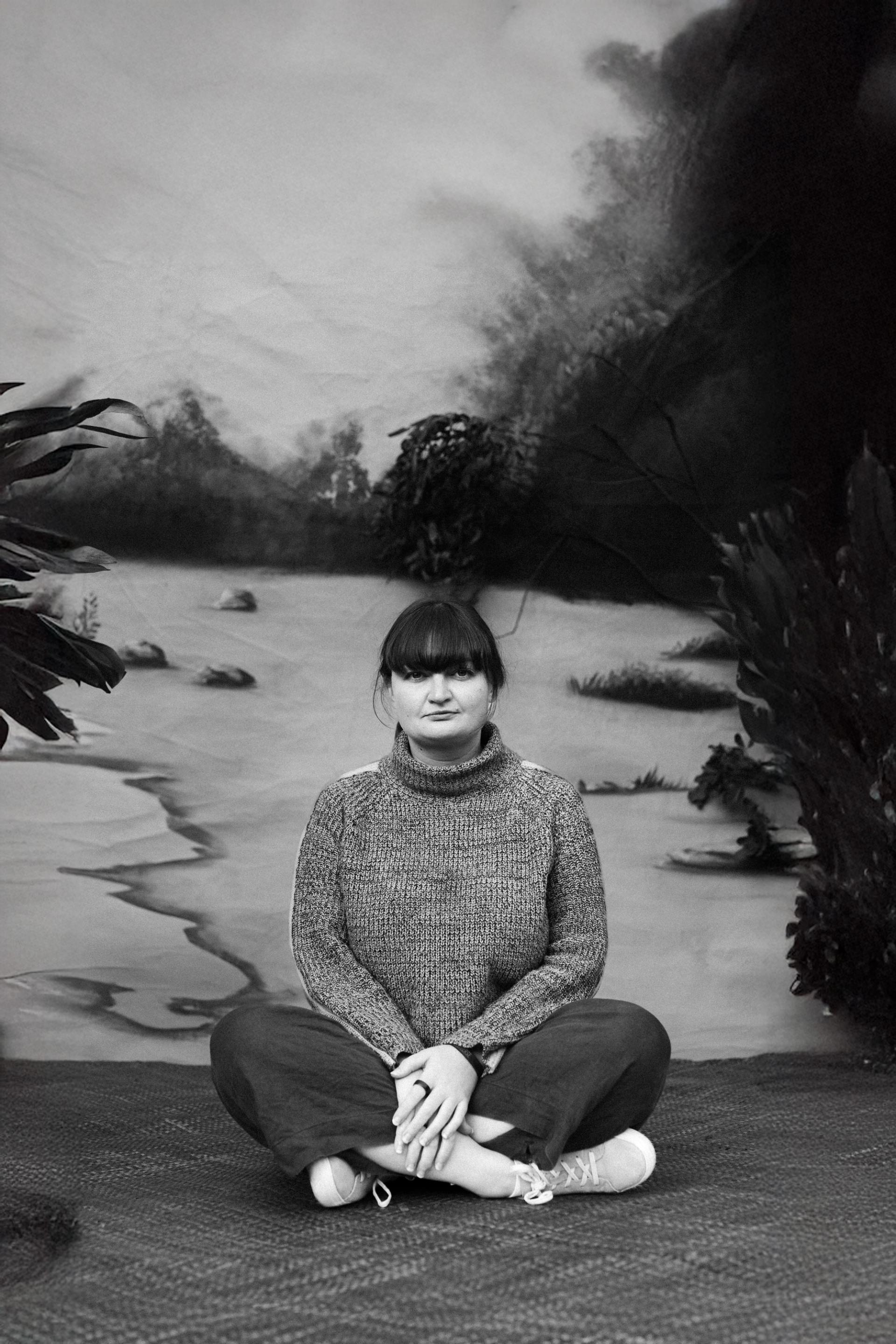
My name is Sarah Lynn Rees. I’m a Palawa woman descending from the Trawlwoolway people of northeast Tasmania and live and work across Wurundjeri, Boonwurrung, Bunurung Country. Also work in architecture. It feels like forever ago since I graduated, but I’m sure it’s not that long.
My family grew up off Country and if you know the history of Tasmania, it’s very fraught. People were removed from their Country quite early on and a lot of generations, particularly my father and my grandparents’ generation, are about hiding, publicly, who you are. We grew up talking about our identity and where we’re from and what those stories were and what they meant to us at home, but it was never something we could talk about publicly.
I was reflecting this morning about my time in primary school and actually, a really ahead-of-its-time primary school that got all of the Indigenous students together and we’d go on special camps, we’d go and speak with Elders and I grew up with that being really quite normal. And the idea that I’d be sitting here today doing a talk in a public context is really confronting to my dad. Because he’s still in that space where you need to be really careful about how much you share; how you’re going to be typecast as a human being; if people are going to give you opportunity or take it away; and all of that comes from a place of fear.
SLR I’m very obsessed, obviously, with architecture and the built environment and I completely agree that every project we do is reshaping Country in some way; and there’s a huge responsibility in that. And if we can do that in alignment with the values of Country then we’re living our values alongside the profession that we’ve chosen.
Life and time and everything to date has been a bit of a reckoning of trying to understand how you fit into the timeline of your immediate family versus how you fit into the timeline of the profession that you’re in or your practice and how that all comes together. I think there’s a constant battle and a constant fight but there’s an intention behind that of wanting the next generation to not have to do the same. And I think my dad, in his way, did that for me by keeping the stories alive in our home and I want to do that for the next generation, which is really about the next lot of people that come through architecture don’t feel like they have to leave their culture at the door and that it’s actually something that is celebrated and expressed.
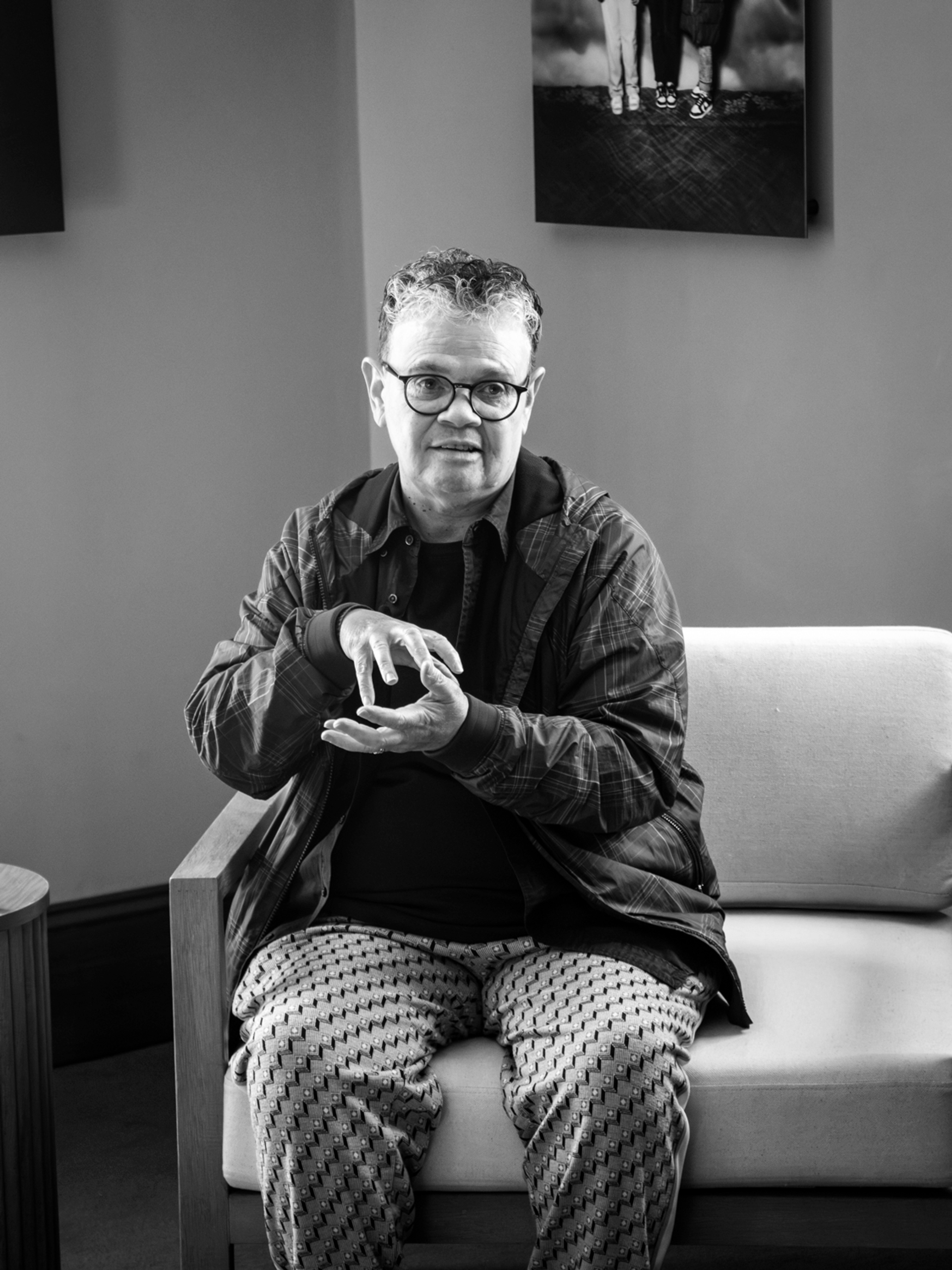
r e a My name’s r e a. I’m from the Gamilaraay Wailwan mob in the central west of New South Wales, which is where the Warrumbungles is located. My father’s a Biripi man from the coastal area just inland from Port Macquarie. I’d also like to pay my respects to the Traditional Owners of this Country in which I’m speaking today.
I work in the experimental digital arts and I’ve been around for a few decades. To be an artist is a completely different journey as an Indigenous person. Whether you’re a writer or whether you’re a filmmaker, the whole time thing around that is, it doesn’t match. My practice started at the Eora Centre, actually. I left school when I was in year 10. I worked for probably about six years: crazy jobs, factory work and all that kind of stuff, and then I just went, ‘I need a trade’.
Before I ended up going to the Eora Centre I actually went to TAFE to become an apprentice electrician, which I finished, but I didn’t finish the time on the job. And then I realised that it was the technical aspect of the electronics that really related to my work. And I didn’t know that it was actually developing then, because I went to the Eora Centre and then I had the intention to go to art school to be a painter. And when I got there, I realised that was the biggest mistake of my life if I went down that direction, because being an artist from the East Coast, I would be playing into the constructed narrative of what an Indigenous artist is supposed to be. And I felt like that wasn’t about who I was. I needed to work with the tools that were given to me through colonisation to reinterpret and reflect back that journey.
Beginning as a photographer, ended up really working in multi art form practice, primarily I work in an experimental video/sound/digital art space. So that the story I am trying to relay is something that you experience in your own time and in your own space. I felt like the two dimensional work wasn’t actually working for me back then. I just got a post doctorate at the University of Melbourne and I’m doing a whole body of research around family lineage, moiety and clans from the Gamilaraay mob.
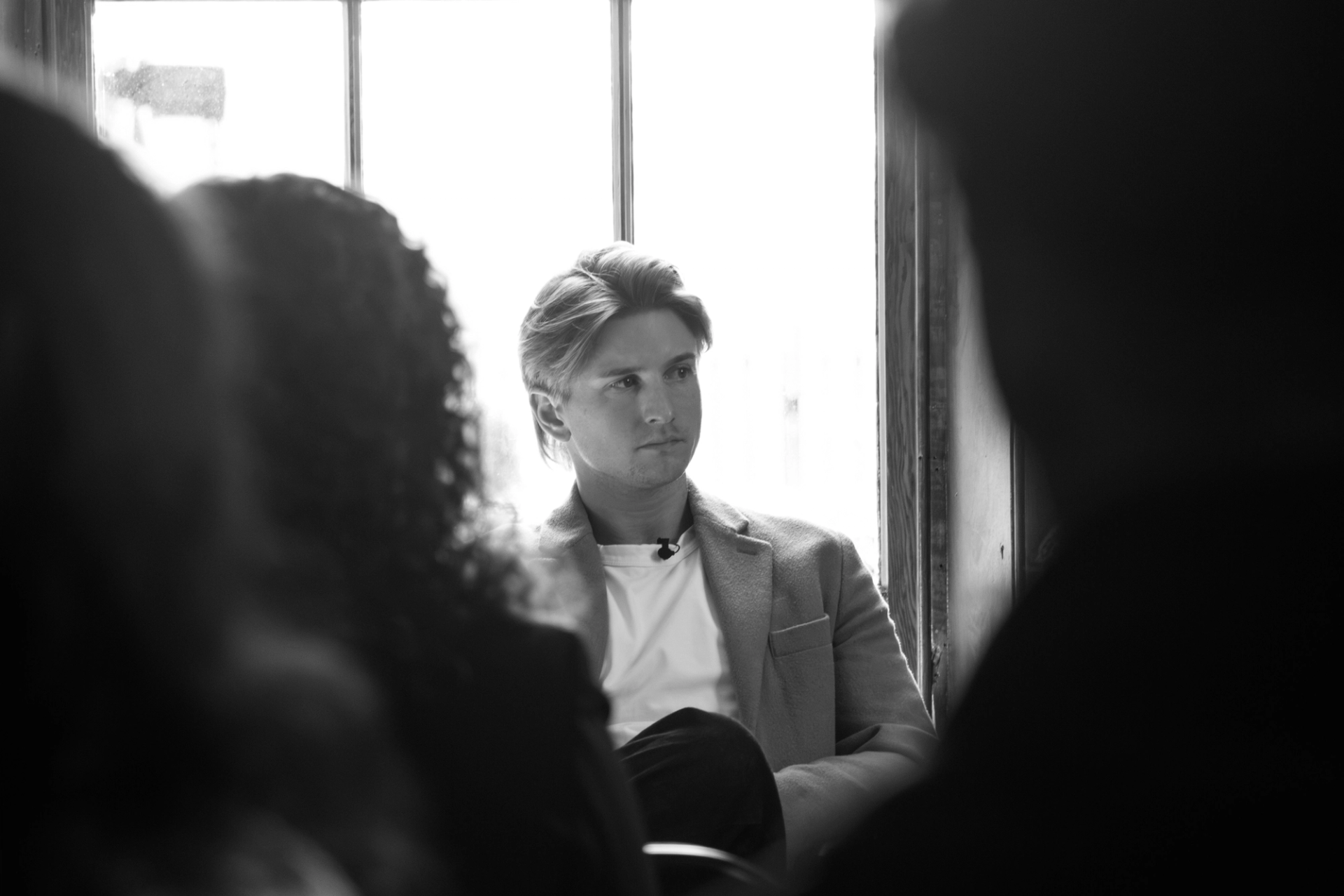
Matte McConnell Thanks, Sarah; thanks, r e a. I’m a Wiradjuri Dabee man. My ancestors and my family have always been connected to what’s now known as Rylstone and Kandos and the Capertee Valley, so I come from a very beautiful part of the world. Very privileged to call that place home and I’m very privileged to be born there, grow up there and still be connected to that place; something that wasn’t afforded to my father and my grandmother for obvious reasons. My great grandmother took my grandmother and her brothers and sisters away in a time that wasn’t safe for them to be there and a life destined for them, and my grandmother returned and we’ve been reclaiming our stories and knowledges and language and practices since then. So I hold a huge responsibility, I think, to heal and relearn and reclaim those.
Where that kind of sits in my practice: I studied architecture at UTS [University of Technology Sydney] and now working in the school as a lecturer. And then I have my own spatial design practice, garigarra (opens in new tab). I would say my undergrad, I felt I never really understood the connection between myself as a Wiradjuri man and architecture. I just felt they were quite separate and I held quite a deep guilt, I think, for picking architecture.
You know, first one in the family to go to uni and get that opportunity. I should be a lawyer or a doctor or a teacher and go home and give back. But then I found responsibility of care for Country to reclaim knowledges, to make space for ceremony as hugely spatial and architectural, and I think that’s when my practice transformed and that is why I do what I do today.
SLR We’re going to talk about a couple of different themes: we’re going to talk about time; we’re going to talk about our body and space and what that means to spatialise our body; we’re going to talk about this idea of nourishment and care; and we’re also going to touch on the theme of No Space is Empty and what that means to us in the context of our world views. We’ll start with time.
We had a yarn before the yarn. It reminded me of this story that an aunty told me once when I was learning to weave in Ngunnawal Country, and she was teaching me the way of weaving in that particular area. My first one wasn’t very good and then the next one got a bit better and then over the course of the day I’d woven probably six or seven different small things. And the last one I wove was this basket, which was very wonky, and out of all the ones on the table, that was the one she picked up and asked, ‘Can I keep this one?’ And then she told me this story about how she conceives of time. So, it’s not my story, but she shared it with me with the context that I could then share it on.
The idea that this basket is woven and it has many holes in it, and she explained that the basket gets lowered into a river or a running waterway or a creek and the water actually moves through it, so the basket might stay still in time and that is our experience of the world, but time is running through us. It was quite a simple story, but it’s one of those stories that I keep coming back to over and over and over again in my life, to the point where now, in my world, the version of the story is: you’re the basket in the river. The physical impact of you being in the river changes the course of the water, so you impact those around you. Those who’ve come before you impact you. The water moving through, in this context of folded time, comes from the creek, goes out into the ocean, gets evaporated up, goes into the sky, gets rained on down the mountain and comes back down again.
And so, it’s this cyclical picture in my mind of what time is and the impact that we have on it when we’re in this space and in this moment. With that comes responsibility to Country, to ourselves and also to the future generations, the past generations. To me, that’s how I see time. The idea that past is present is future. This expression of time that we’re in feels linear, but it’s definitely not. How do you see time, or what does time mean to you?
R I was thinking about this earlier and trying to reflect back on my early practice and early life, and my introduction really, into this colonial society because I’m a child of the assimilation policy. I’m the last generation to be in a mission system and then we were assimilated into town, on the other side of the railway tracks. So, I grew up in White Street, Coonabarabran, with all the Blakfullas and one poor white family.
By the time I left the mission system I was about four, so I started to have more memory of that place. What I realised is that I grew up with this community that protected me, that gave me a sense of safety and the ability to feel like I could do and be anything that I wanted to be. But the public school system began to beat that out of me. And so, there wasn’t really a ‘time’ thing, it was the comfortability and the nurturing of community and Country.
My first realisation that time was going to be interrupted was really when I stepped outside of my community, because you learn as an Indigenous person to live between these different worlds. We’re integrated into a society that’s about individualism and that goes against the grain for most of us because we’re about community and, like you were saying Matte, ‘What is our responsibility?’
My mum always wanted me to be a welfare worker and if you weren’t going to do that, a lawyer or a doctor. And I just saw that they’re all about helping our mob to survive colonisation. I thought there were plenty of mob doing that, so I needed to try and think about what I could do that was different. And I chose something that my family completely don’t understand. For many, many years I’d go home and everybody in the town would go, ‘How’s your painting going, r e a?’, and I didn’t have the heart to tell them I wasn’t a painter but I also didn’t have the language to tell them that I was an artist working in new media arts and experimental digital processes, because I was trying to still understand why that became my medium.
R It’s taken me over 30 years to get to that stage, to now be really comfortable with who I am and comfortable with the language. I’m not quite still comfortable with the idea of shapeshifting in and out of Country and community and being in this world that I’m in as an artist. One of the things that happened and other people will probably identify with this, is that when I stepped outside of my community, of safety and care and comfort, I stepped into a world that didn’t know me: I was invisible, I had no identity. And then the identity process began: ‘Who are you? Where are you from? How much are you? You couldn’t be really Aboriginal.’ All those things that I had to go through as a kid living in Sydney coming from the Central West really impacted on my journey as an artist, understanding this sense of no time, really, in terms of my community.
There were no restrictions on what and where and when I was supposed to be. There was the, like you were saying, Sarah, the cultural flow that was constantly happening. And for me now, when I step out into this society that I live in, it gets clogged up and when it gets clogged up, I have to go home to Country.
It took me a long time to realise that I wasn’t just going home for family because my family, like a lot of mob, are struggling with the impact of colonisation, and have never left these little Country towns, and I’ve had this world experience. So, seeing through those difficulties and starting to really understand that I have an important role in my family, which is why my research now is based back in Country around family lineage and moieties and cultural knowledge systems; to leave that for my family. Because that is the one thing that they will understand that might make some sense to the next generation— where the art fits — because the art is how I come to know me. It’s how I come to be connected back into that constant flow from my ancestors and my Elders.
It’s really interesting that I’m on this panel too, with these architects, because that’s what I wanted to do if I didn’t end up in art school. It really had that connection to spatialisation. I can make that connection now through my practice. And hopefully sometime down the track we might get to work together.
‘The co-option of your time into the colonial system removes you from the ability to exist in a timeless space with Country and with community.’
SLR The co-option of your time into the colonial system removes you from the ability to exist in a timeless space with Country and with community. I feel that completely. If you think about the barriers of connection that we have at this point in time, I didn’t grow up on my Country. Most of my Country is either a private area or a ski lodge. One of the only places you can go is Batman’s cottage — one of the bounty hunters that killed a whole lot of my ancestors (opens in new tab) — so the things I think that we crave to make ourselves feel nourished and healed in some way are so co-opted by the fact that we don’t have time to do them.
MM If we think about Country as a living archive holding memory and then our role as architects, we either erase that or disrupt that memory or we can draw upon it. That site is never empty, it’s never objective that these places have memories.
r e a, when you were talking about your healing, through the lens of time, I’ve connected with that through my healing. There’s a jump in the timeline because your ongoing healing is also my ongoing healing and we can talk about that with bodies in space and what that means. Also through healing: my healing is my grandmother’s healing is my nieces’ and nephews’ healing is my children’s, if I ever have children, and their children. Time is not linear in that sense, it’s messy and it’s not a straight line — it’s this spiral.
SLR It’s funny you say spiral. That’s one of the versions of time I tried to draw. I’ve got two in my mind. One is: there’s a whole lot of circles and you’re one of them. It’s like a hula hoop, but the circles of the hula hoop are all different sizes and as you move around them they intersect with each other at different points. Those intersection points, those moments where we come together or how something in our life impacts us — they never leave us. They’re still orbiting us in some way and then we’ll eventually find them again. That’s one version. The other one’s got lots of things that spiral off each other. I will draw it one day; maybe that will help me make sense of it.
You touched on this idea of bodies in space, and this became a huge part of the way that we started to think about time because we occupy a time, we occupy a space, but we’re also occupying that across thousands of generations. The boxes that have been put around us don’t allow us to do that freely anymore. And r e a, you talked about this idea of finding your identity through your practice and you’ve sort of gone on this arc of resisting the painting, doing the digital art, wanting to hark back to this idea of architecture and something spatial and you’re interested in the sensorial experience and your body in space. So, I wondered if you could talk to us a little bit about how that influences your life?
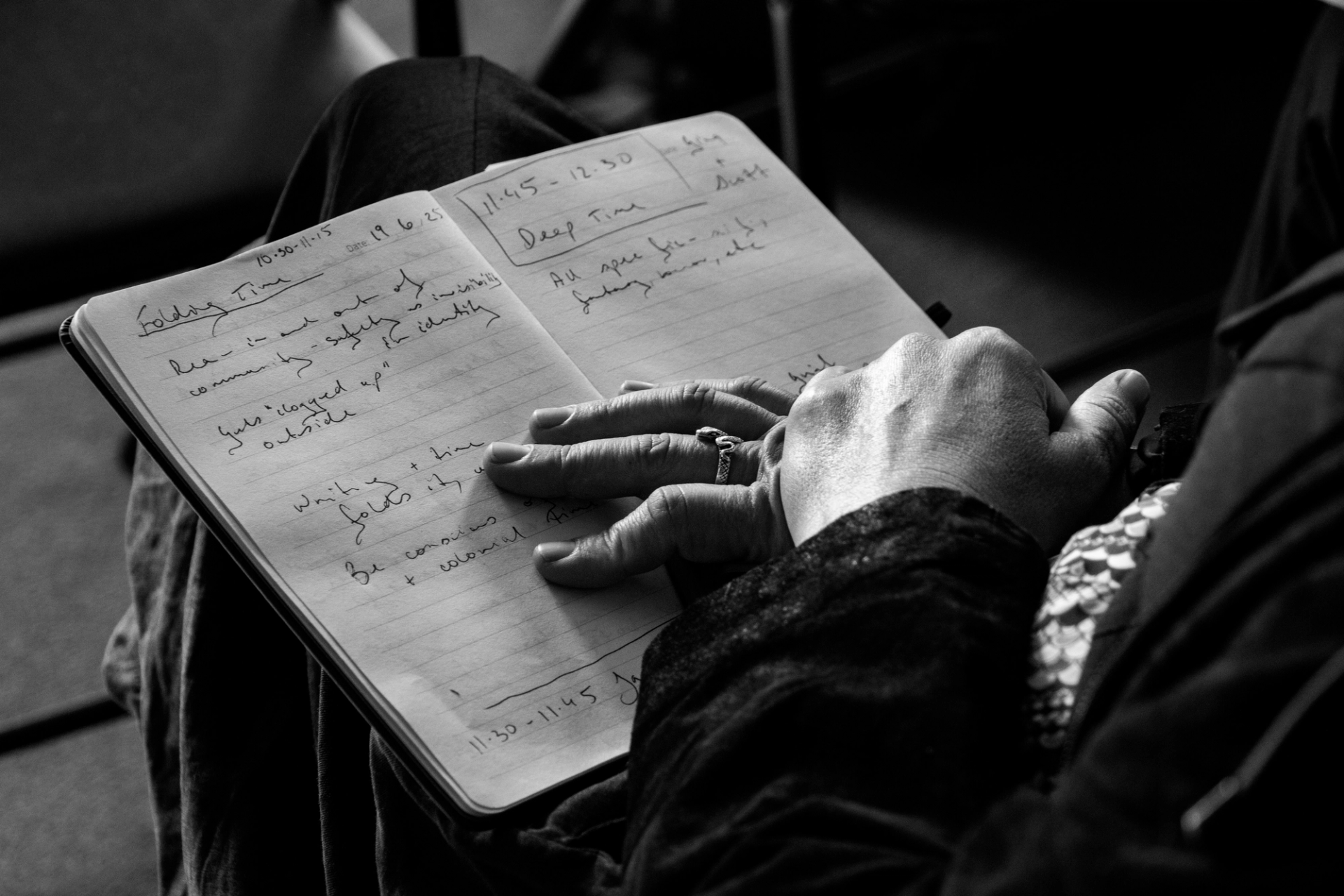
R One of the things I’ll say just before I talk about that, is about language. I think it’s really important to be conscious about this colonial language that we’ve all been constructed in, in some way, shape or form; to actually think about the journey that we’re on as Indigenous people in whatever we do in the world is in a collision point with the crazy. The crazy is the colonial space.
I was lucky to grow up with my mob and to have that strength and courage that was from my grandmothers, really. The two grandmothers were really strong, strong women in my life. One of them was stolen but ended up being able to return to her mob because her father was in the Light Horsemen and he was allowed to write to his daughters at Cootamundra, so they knew where they came from. They were from a little town called Manilla, just outside of Tamworth, which is Gamilaraay Country. My other granny was a bush woman and she never got disconnected from her Country. She had all these traditions and these connections to Country. I haven’t had a problem with being who I am in the world, but the world has had a problem with how they construct who I should be. That’s been my collision point around language.
As an artist, I had to find safe spaces and safe environments to talk about who you are as a whole. I’m a queer, non-binary artist and it probably took me 20 years of my practice to even speak those words, because I was still trying to understand all of the labels around my identity as an Indigenous person and the impact as also a person in a female body. When I turned 50, I started to think about how I felt now that I don’t have 50 years down the other side. Now I’m in my early 60s I’m in that ‘I don’t give a fuck’ period.
‘I’m a queer, non-binary artist and it probably took me 20 years of my practice to even speak those words, because I was still trying to understand all of the labels around my identity as an Indigenous person and as a person in a female body.’
R I'm now doing all the things that I really wanted to do 30 years ago, but I was too damn scared because I'd been integrated into this society through all these rules. One of the rules that really stuff up who we are, and I don’t have anything against Christians, was Christianity. I had a mum who was really strong in her culture, but strong in that [faith], and so she already had this collision point in her own life that she introduced to us and we had to try to understand the difference between Christian ideologies and spirituality and to find that connection and understanding in terms of Country and my journey.
I wanted to write a PhD about the lack of writing around new media artists who are Indigenous in this country. But you know what kept coming up? My own trauma. So, I wrote a PhD about my trauma and what it was like to go back home to Country as a kid in those early years and the anger that kept coming up because I didn’t understand why I was living in Sydney, why I didn’t have these same connections and understandings of Country. Until I went to university and I was an undergrad, that was the first time I figured out the whole story of colonisation and the impact across this country and where my family sat in that story.
I then started to understand the way that I was being constructed and began deconstructing that. By the time I got to the PhD, it was about, ‘How do I go back to Country and find who r e a really is?’ It was about changing my story because the Country that they created, the colonisers, and the systems that they created, were actually not mine. They just created a shade across my Country and I had to pull that shade back. So, that’s been my journey and will now be a journey of, ‘I don’t give a fuck’, for the rest of my life.
SLR How do I get there sooner? Oh, to be free. Wouldn’t that be nice. What about yourself, Matte?
MM I want to talk about the shade too, the shade cloth across time. My great great great grandmother and great great great worked as domestic servants or housemaids, so there’s that shade, that connection, that disconnect with our ancestral Country and those systems being set up.
Then my grandmother and my father, in the generation where children were being taken and seeking safety elsewhere off Country, and now myself. I hold this guilt, firstly, living and practicing off Country, but then also not feeling a level of safety when I go home as a gay man, in a small country town. And then this guilt I feel when I come back to Sydney and I can take a breath and I feel like I’m safe again in the heart of Surry Hills. There’s that huge tension and that collision. For me now, the healing is peeling back that layer, that that’s actually not Country, that that’s just a small part of it.
Thinking about my body on Country, there’s that weight, it’s tense and it starts to peel back when you’re burning Country, or I sit in the river with my niece and my grandmother and there’s those moments that make it all disappear and you forget. But there’s also that layer that exists across time, I think, in the way that these colonial structures, impositions, traumas live on but manifest in different ways.
SLR I can definitely relate to that in the sense that I didn’t grow up on Country and there’s not many places that I can actually go in my Country. But then also, the context of community in Tasmania, given the hidden generations that are in my family, like, I don’t have that sense of community at home. I’ve got it with my family, but beyond that I’ve actually met more people that I’m related to living in Melbourne than I have at home. I feel more safe in Melbourne, which is not my Country, because I’ve had aunties and uncles from those communities where I’m working go, ‘Okay, you’re trying to do something, let’s teach you and bring you in and show you what’s important for this Country.’ So, even though it’s not my Country that I’m working on, that’s where I find the safety and the comfort.
I’m actually genuinely quite terrified about the idea of doing a project on my own Country because I don’t feel like I have been given the rights or the permissions by the right people to do that. And the idea of reshaping a Country, of scarring the Earth in some way — hopefully in the process healing it if it’s already been scarred — it’s a huge responsibility and it’s something that I think we, as Indigenous people, understand that there are protocols that we need to follow and that our professions don’t allow those or facilitate those to happen.
So, there is a constant state of conflict. I feel like I have an existential crisis every day, to be honest, because you’re trying to change the systems that we’re working within so we can have better outcomes for community, so there is time for the voices of Country, spoken through Traditional Custodians, to influence what should happen in place. But then, the world expects you to perform. That, for me, is something I’m always trying to work through: how do you actually live by the values and the protocols and the rights and allow Country to have authorship through the work that we do? While also then being told, ‘No, you can’t, no you can’t, no you can’t, no you can’t’, or, ‘you don’t fit, you don’t fit, you don’t fit.’
We’ve talked a little bit about this idea of nourishment and care and what it is that we’re all seeking in order to feel whole. I think that’s a really beautiful way that you put it before r e a, about the bits that we feel are missing and this idea of practicing care for Country or sitting with your grandma and your niece in the river and these acts of care actually are all so nourishing for us. That is the reciprocity for us. We talk about reciprocity of non-Indigenous people and Indigenous communities all the time, but the reciprocity actually is in that active care with Country and the time in which we do or don’t get to do that.
‘Even if Country has been subject to horrendous abuse, there’s a starting point that is deeply enriched in the layers beneath the soil that can tell us about place, but also about the stories and the living memory that exists within the communities that we work with.’
SLR We can talk about this idea of No Space is Empty because that’s a pretty big statement which I think we all innately feel is absolutely true, but in the profession of architecture, it’s often not considered to be a reality. The typical practice is to flatten a site, remove all the trees, build something and then put landscape around it. And that is traumatic.
Weirdly, somehow all the projects I’m currently working on are revitalising car parks, as in ripping up a car park and returning that place to something Aboriginal and healing Country in some way, so that’s quite lovely. But the language that’s used in our profession is it’s a ‘greenfield site’ or ‘it’s empty’ or ‘it’s a brownfield site, it’s contaminated.’ That’s the label that gets given to it and if you follow that logic of how you’re taught to do architecture, then you’ll look at all the buildings that are around you and that is your reference point — your reference point is now — and how do you design something in the context of that reference point?
I think the gift of Country in the context of architecture is that we understand that the geology is hundreds of millions of years old and it tells a story about how this land was formed and where it was previously connected. It creates the soil and the DNA, which gives life to the plants and then the animals and the insects feed off of those and move them around and then there’s this interconnectedness between all of these different Countries, the way that water has carved and shaped a landscape.
Even if Country has been subject to horrendous abuse, there’s a starting point that is deeply enriched in the layers beneath the soil that can tell us about place, but also about the stories and the living memory that exists within the communities that we work with. And I wondered if you wanted to close this out by talking about what No Space is Empty means to you?
R It’s interesting you talk about those names in relationship to different sites, because for me, it’s about the body as the site. The two major conflicts in my practice have been this notion of urban and traditional, which really are just shit. They need to get rid of that because they are labels that basically say, ‘you’re real’ and ‘you’re not real’ — and they keep the separation. Contemporary art created those labels because it’s about money making. And that in itself causes so much trauma and so much disconnection between artists. So, it’s a system we’re fighting against. That’s why I moved from all these outer things to the inside, to the space of the body as the carrier of culture and history and identity. It brings me back to that sensorial experience.
Over the last nearly 10 years of my practice I’ve been exploring moving from the sensor, within the context of my work being a trigger, to the sensorial experience within the body.
There’s this whole bunch of work that I want to make, but I don’t think I can make it until I learn to speak my language, because speaking my language will give me a completely different sensorial experience than the English that I speak. And the English I speak doesn’t actually really name what it is. Which is why when you’ve got to do those stupid bloody grants and you’ve got to translate them into some kind of English that people who are English read and give you money to make work about your body is bloody insane — it’s a whole chaotic journey in itself. I don’t necessarily know where I’m going to go, but I am following an energy, a sense that is from Country, really. The work that I want to make will stem from speaking my language and understanding who I am.
MM When we think about a site as an architect, it exists in this moment, like the context of the built environment. But there’s ancient stories and knowledges and practices that exist on that place, in that place, with that place. And how we do that, I think, is really hard. We're all conditioned to think objectively and exist as neutral bodies and practitioners. Our work has trauma, resilience, care, beauty, all these attached to it. That's what the profession is struggling with and we’re all struggling with; to think about how we actually do that meaningfully, properly, how we fit in that timeline while also respecting our cultural protocols and Country’s protocols but then also thinking about language and bodies in space.
‘To sit and hear someone speak Wiradjuri is hugely healing.’
SLR I don’t know a lot of Palawa kani, which is reconstructed language from the remnants of the languages that exist in Tasmania. The first time I figured out how to do an Acknowledgement was actually at a quite intimate Indigenous-only architecture day and I did it and I just cried. I could barely do the talk because it hit a note. It makes me emotional even thinking about it. It’s something that has taken away from us that when we get it back, it just hits somewhere.
R It’s really amazing to be an Indigenous artist in events like this, which we don’t have very much at all. I come from the kind of early period of NAISDA (opens in new tab), Bangarra (opens in new tab), Black Theatre; everybody connected. And I know that social media, the internet, the whole system has got something to do with that but we miss out on this connection and we don’t get the nurturing and the support from our peers and from those that have come before us and those who are coming after us without being in spaces like this. It’s a privilege to be part of this today and to be in a space that I feel that is safe.
And the other thing that I wanted to say was really about protocols. We put every bit of fucking energy we have into creating cultural protocols to protect our mob’s stories and they are now gatekeeping processes that keep us out of those spaces. So, we need to really rethink that we wrote those protocols to stop non-Indigenous people from raiding them constantly, freely, but we are still the ones who cannot access them.
So, there’s something to have a conversation about there. And something to be reworked and rethought because we are not individuals, we are community. So, we need to be able to have access to the same information that everybody in our community has access to. We need to try and break those systems and ask ourselves, every time we come up against them: ‘Am I here because I’m here because of r e a? Or am I here because of my community?’
SLR We’re so collectively aware of what time has been taken away from us or from our family and what comes with that. And the idea of connection to community or knowledge or language that empowers us to then actually be the people we want to be in the world. So, nothing simple, but I’m really grateful that you joined me for this yarn today. And I hope that the threads of this continue to emanate throughout the day and we circle back or spiral back or we’ll hula hoop back and we all end up in our ‘don’t give a fuck’ era really quickly.
Knowledge Holders
About the Series
No Space is Empty is a First Nations knowledge symposium exploring time beyond the clock. The digital series encourages us to consider how different temporal frameworks shape our worldviews, relationships and practices.
The live symposium was held on Gadigal Country at Sydney Observatory in June 2025.