On Custard

Noëlle Janaczewska, the award-winning playwright, poet and essayist, has been commissioned by Powerhouse to write about objects in the Powerhouse Collection (opens in new tab). In this work she tells how a handwritten recipe book from the 1930s inspired a deep dive into custard.
On Custard
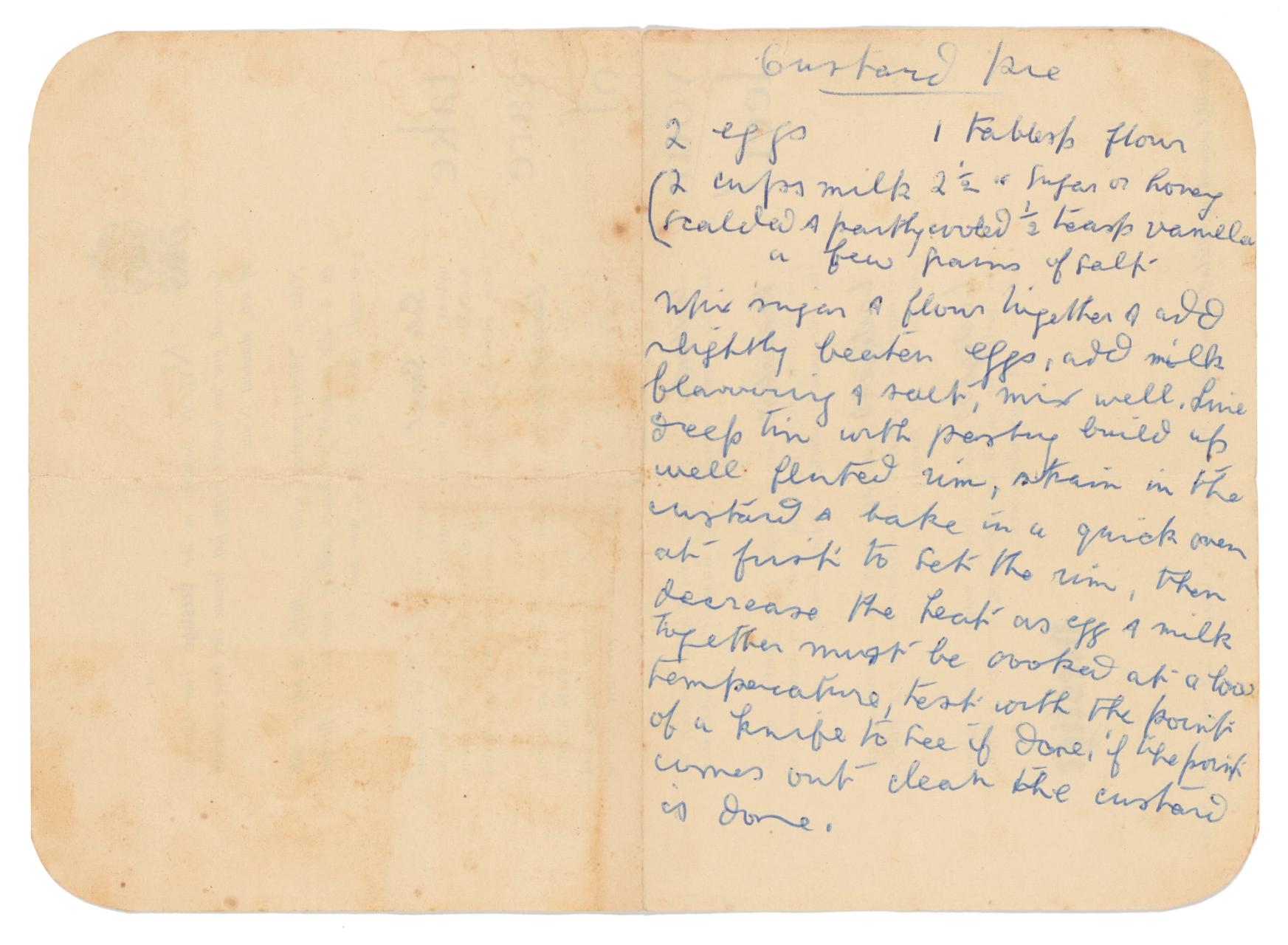
So, custard. This recipe book is full of it. Baked custard, custard pie, different takes on custard sauce. A selection of savoury and sweet custard tarts: ham and onion; haddock and tomato; date; caramel and orange; sultana and more. Recipes handwritten, typed and torn from magazines.
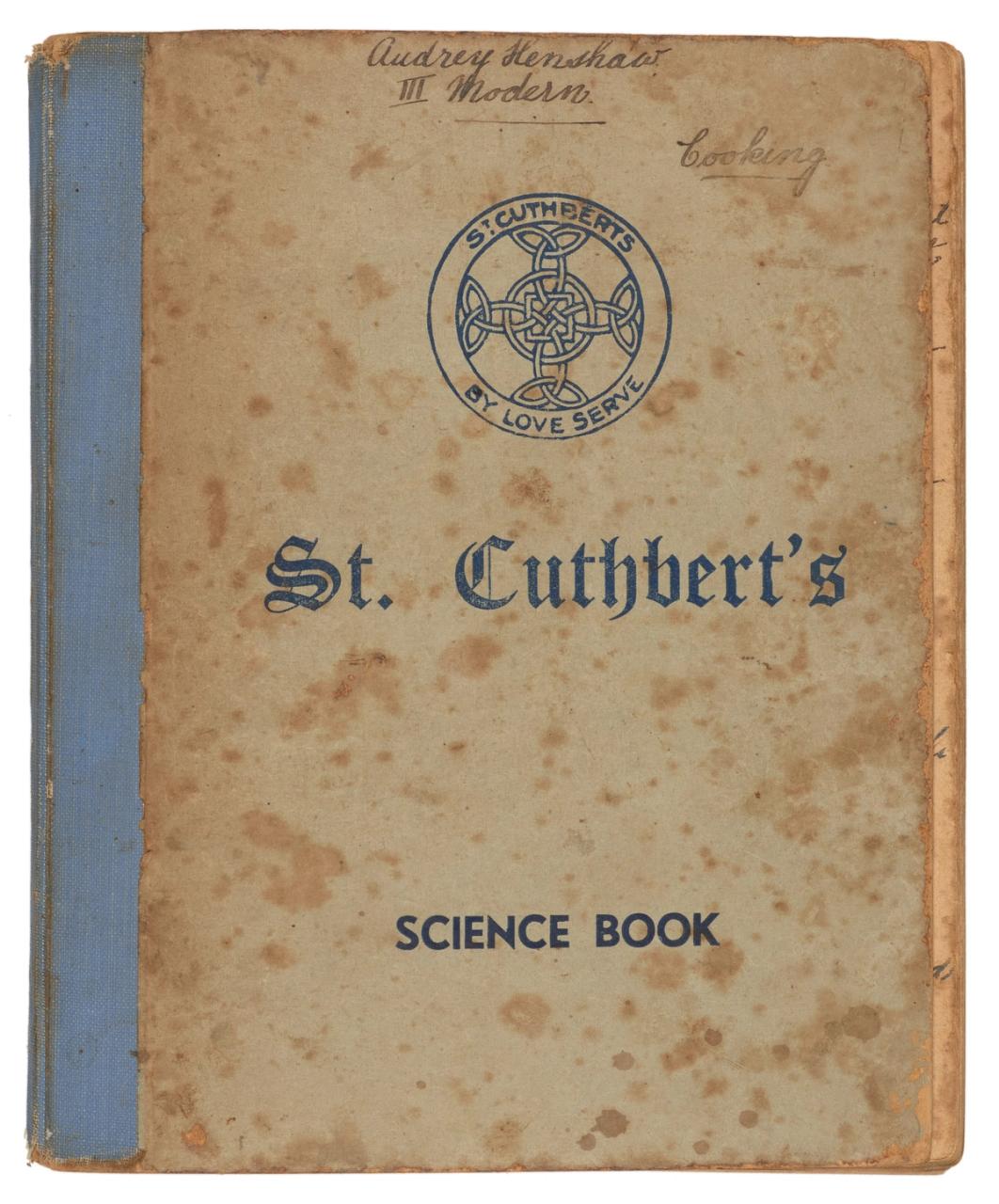
It’s a homemade cookbook this one – a personal assemblage of recipes, guidelines and loose sheets used by one Audrey Henshaw in the mid 20th century. The book started its life as a science notebook from St Cuthbert’s College in Auckland. Rules (for Preparing and Serving Salads among other things) copied out in a neat schoolgirl hand, headings underlined and ruler-straight. But as well as Audrey, at least one other person has added to this book. And at some point it travelled from New Zealand to New South Wales.
There’s peach jam and three-way biscuits, walnut croquettes and mock salmon. There’s also a hymn sheet, a knitting pattern and instructions for a gadget called a ‘Food Glamorizer’ which looks like a kitchen version of the Swiss Army knife. But it’s the custards that interest me.
They take me back to classes at school. Where I baked a custard tart in a too-hot oven and ended up with a pastry shell full of scrambled egg. A disaster that convinced the unfortunately named Mrs Hoare to let me do art instead of cookery – sorry, ‘Home Economics’. As for Audrey, she began her cookery book several decades before my culinary flop. When the teaching of domestic arts was to prepare the housewives of the future.
In Britain custard is ubiquitous. While Americans serve their cakes and desserts with whipped cream or ice cream, the British pour custard over fruit crumbles and steamed puddings, fold it into fools and pipe it into buns. They fill biscuit tins with custard creams and workplace canteens ladle pink custard over squares of chocolate sponge. It’s a quotidian and versatile cover-up. Custard can hide broken pastry, lopsided flans and disguise over-stewed rhubarb.
In the 1940s – when Audrey was writing longhand about washing lettuce leaves – Australian (and New Zealand) home cooks relied less on books and more on recipes passed on by neighbours and family members. Or snipped from newspapers and food packaging. If they owned a cookbook or two, chances are they were English publications replete with distant tastescapes and the legacies of colonialism.
After my first encounter with Audrey’s – and whoever’s – recipe book, I took a deep dive into custard. What defines it?
At its most basic, it’s a mixture of milk and eggs thickened over a low heat. Where did it come from? It became popular during the Middle Ages – although its history may go back further, to Ancient Rome. By the 18th century it was regularly appearing in European cookbooks. Elizabeth Raffald devotes a whole chapter to ‘Observations on Creams, Custards and Cheese-Cakes’ in her 1769 tome The Experienced English Housekeeper.
There are three main types of custard. Pouring custard aka crème anglaise. Confectioner’s custard or crème pâtissière which is used as a filling for eclairs and fruit tarts. And set custards which are baked. Plus the outliers: custards we don’t generally think of as custards, such as quiches and cheesecakes and bread-and-butter puddings.
Custards freestanding and liquid. Custards made firm with cornflour, gelling agents, beaten egg whites or, occasionally, breadcrumbs. Custards flavoured with sugar, vanilla, citrus and chocolate. Festive custards laced with liquor. Custards homemade, readymade, made from powder.
Custards that generate streams of Instagram photos.
Custards flung in faces for laughs.
When comedian Mabel Normand hurled a custard pie at fellow actor Roscoe ‘Fatty’ Arbuckle in the 1913 film A Noise From the Deep, she started something. Soon custard pies were flying across screens everywhere. A slapstick set piece. Charlie Chaplin cranked it up a notch when he staged a pie fight in Behind the Screen. And in 1927 Laurel and Hardy’s The Battle of the Century got through more than 3000 pies. Or so the legend goes.
These barrages of custard and pastry, like other comic tropes of early cinema, had their origins in live performance, in vaudeville, circus and commedia dell’arte.
Keystone Studios, the producer of A Noise From the Deep, became famous for its pie-throwing rough-and-tumble. Initially they ordered regular pies from a nearby store. But as pie fights grew more elaborate, a special projectile version was created using heavy-duty pastry with a mock custard filling of flour, water and cream.
Histories of silent cinema tend to be a bit boys’ club. Until recently not much attention was paid to the women who took the spills and knocks and got pelted with pies. Or who – like Normand, French filmmaker Alice Guy-Blaché and others – got behind the camera and directed comedies.
Some blamed Walt Disney for slapstick’s demise. His cartoon characters could crash headfirst into brick walls and bounce back, could perform stunts impossible for human clowns. But Mickey Mouse was only part of the changing picture. Sound arrived, and by the early 1930s talkies were the industry standard. Along with synchronised dialogue and more subtle storylines. The era of custard-pie comedy was over.
According to an article in a New Zealand newspaper from 1930, while men find slapstick hilarious, women find the tossing of baked goods and the smashing of tableware unappealing. Not because their sense of humour is less, but because it’s different.
After all, when the custard pies have been chucked and the crockery broken – what happens? A woman has to come in and tidy up the mess, mop the floor and dispose of the shards.
From comic farce to PR drama. Outside Hollywood the custard pie has another storied past – as an instrument of protest. Media tycoons, politicians and public figures have on occasions come face-to-face with custard pies. Actions which tap into centuries-old customs of mocking those in positions of power.
A rich serve of traditions.
Milk humming with nutmeg and egg-yolky sunshine. Spoonfuls eaten over the pan. Recipes written into a school exercise book. Breath-long lines in predictable patterns. Until the second contributor inherits the book and the syntax shapeshifts. Abridged directions in faded blue ink dance across the pages. Cooking that is half script, half improvisation. Flip, slice, fine-tune or reformulate the recipe to suit your mood and circumstances.
How much were these recipes used? There are signs of wear and tear. The odd smudge. But the notes you usually find pencilled on working recipes – notes that were all over my mother’s collection – are largely absent.
So, food. More than agricultural products, more than ingredients and nutrition. It’s about the choices people make, and why. About what’s available and affordable, and also what gets advertised. Prominent among this recipe book’s loose additions are three leaflets put out by Carnation: Happy Cooking with Carnation Evaporated Milk, See How You Save and Cooking Secrets.
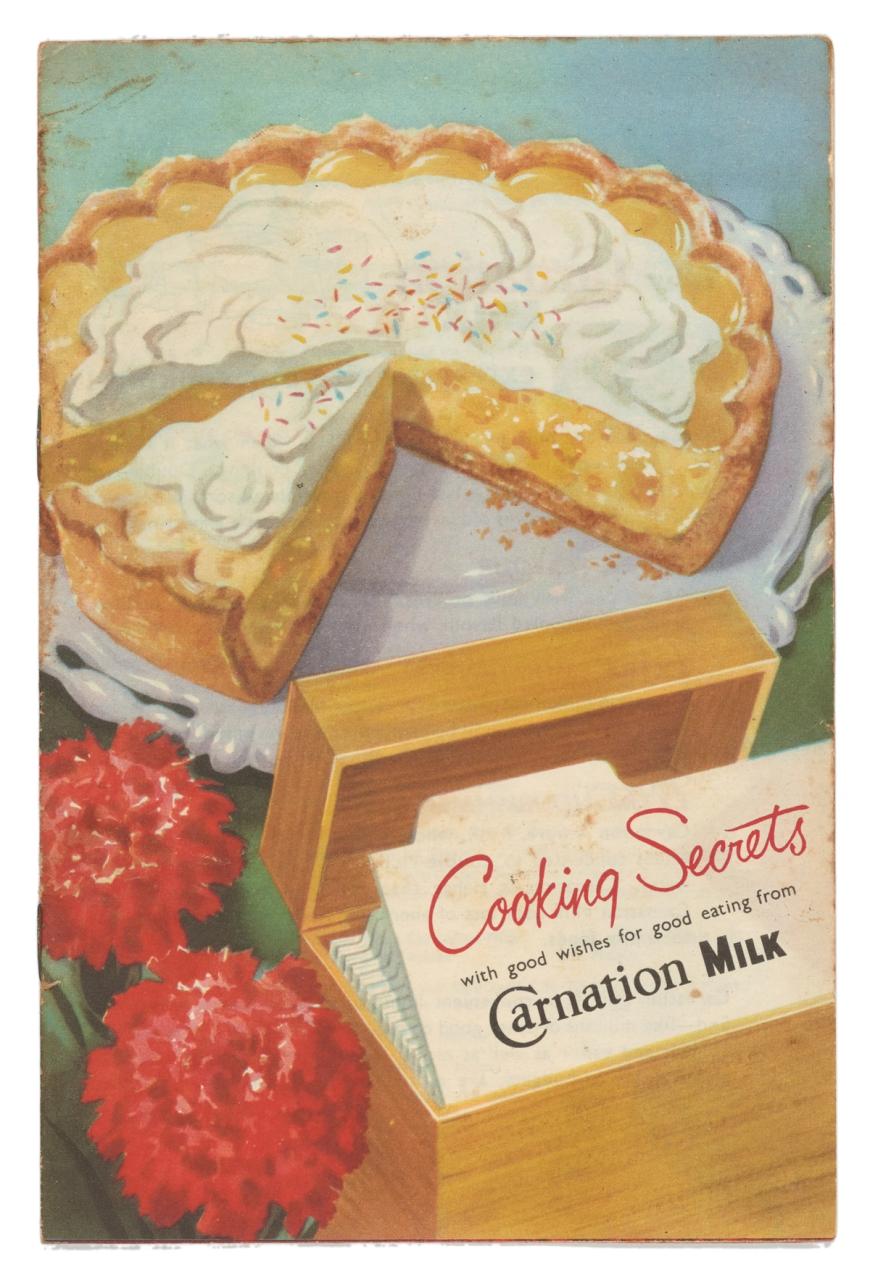
In the 1950s and 1960s (and earlier), food companies printed recipes on their packets and released pamphlets to promote their wares. Do manufacturers still do this? Or has it all moved online? Recipes now circulated via social media and YouTube channels. Carnation’s first marketing booklet The Story of Carnation Milk was published in 1915. Thirty-two pages including directions for cream puffs with custard filling, baked custard, boiled soft custard and custard pie. As Scottish culinary author Elizabeth Craig wrote in Foster Clark’s New Ways of Using Custard, ‘there’s no end to the possibilities of custard powder.’
Despite its strong association with British ‘afters’ and French patisserie, custard’s cultural reach is widespread and diverse. Portuguese custard tarts (pastéis de nata) have taken over bakeries and cafe menus in Australia, Malaysia, South Africa and pretty much the world. Fruit custard is one of India’s most popular desserts. There’s the Parsi wedding custard, lagan nu. Steamed savoury egg custards from Korea (gyeran jjim) and Japan (chawanmushi). There’s knafeh, galaktoboureko, zabaglione, crème brûlée, custard-filled doughnuts, trifle, quindim, the classic coconut custard from Brazil … The list goes on. And on. Then there are all the dietaries: fat-reduced, gluten-free, custards made with soy, almond and other non-dairy milks. It was apparently his custard-loving wife’s allergy to eggs that prompted Alfred Bird to develop his eggless custard powder in 1837. Now a pantry staple in the United Kingdom and elsewhere.
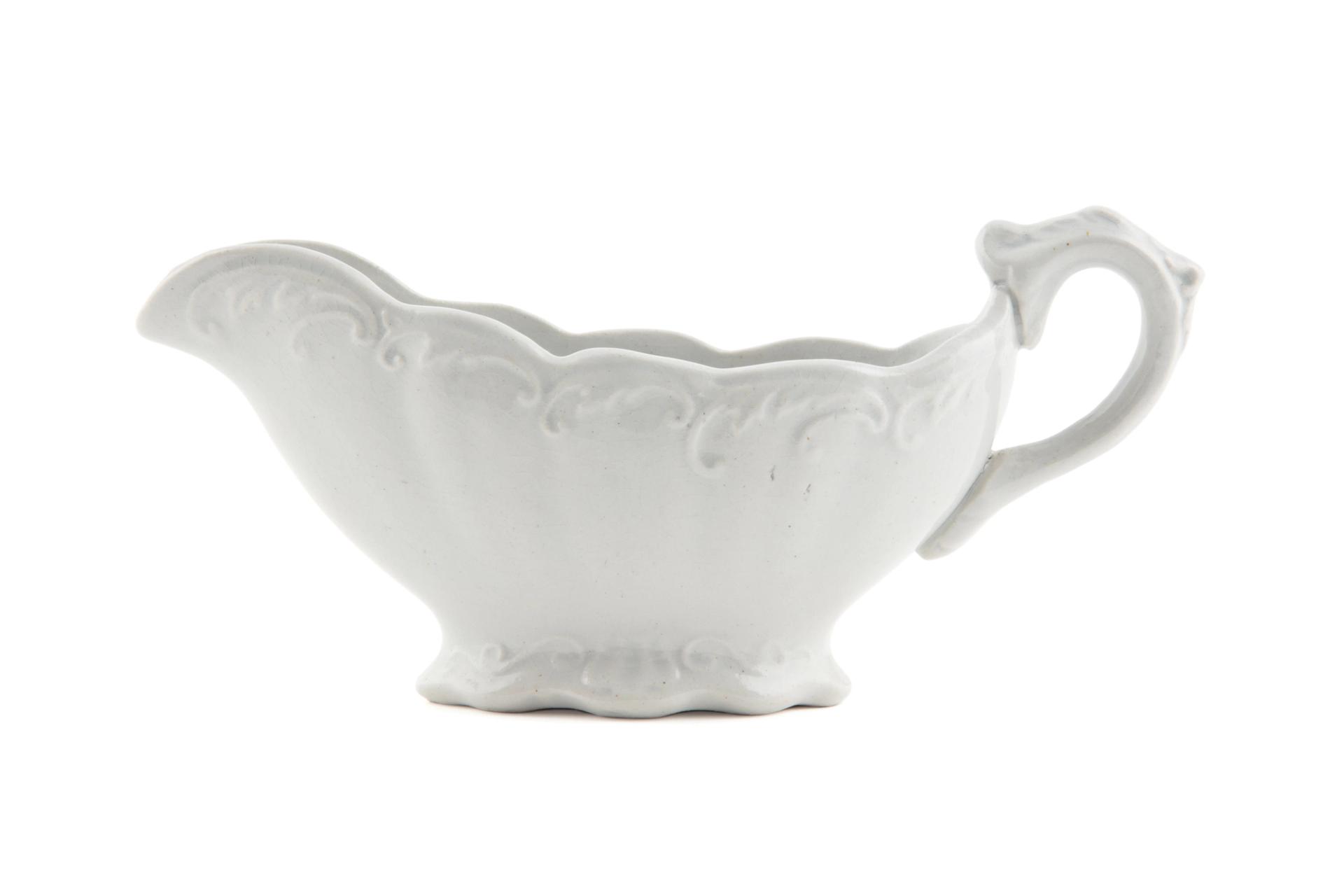
The mid 20th century was custard’s time to shine. A time of egg beaters that had to be turned by hand. Of gravy boats. After my mother’s death I cleared her kitchen for who or what comes next. I took the last dusty piece of china out of the cupboard. It was a gravy boat. An off-white ceramic number tricked out with leaves and berries. I grew up with gravy boats. Shallow jugs which sit on matching saucers. Ours held sweet custards more often than gravy, and at Christmas it held a white sauce enlivened with generous slugs of rum or brandy. As a child I used to imagine myself sailing away to the other side of the world on that gravy boat.
I trawl archives and databases for information about the composers of this recipe book with its custards and ephemera. Details are scarce. There’s an Audrey Henshaw whose name appears in notices of examinations held in Auckland by the Associated Board of the Royal Schools of Music (London). The dates align. Are piano-playing Audrey and recipe-book Audrey one and the same?
I think so.
In the early and mid 1950s she taught music at the Australasian Missionary College, a private institution affiliated with the Seventh-day Adventist Church. (Later renamed Avondale College and then Avondale University in 2021.) In 1956 the Australasian Record, the church’s official periodical, reported that Miss Audrey Henshaw’s rendition of two solos from Bach’s Mass in B Minor, which she sang in Latin from memory, had won her a first prize in the City of Maitland Eisteddfod. A few months later in Newcastle, she was a featured contralto in a performance of the Messiah.
As well as custards, Audrey Henshaw’s cookery book contains a wealth of vegetarian dishes – at a time when main meals without meat were uncommon. The Adventist Church advocates a plant-based diet and discourages animal products, alcohol and caffeinated beverages.
Did Audrey or other users of this recipe book listen to the wireless as they whisked custards and cake batters? What did their kitchen look like? Were there corkboards with drifts of postcards and reminders in neat capital letters?
I imagine routine days full of the unspoken give and takes of fellowship. I wonder what they talked about as they peeled apples, as they washed up …
February 1958, Audrey and a Mrs Henshaw – presumably her mother – left Australia aboard the Strathaird. Bound for the Guildhall School of Music in London where Audrey would be doing further study. Did she give her book with its accidentally expressive recipes to a colleague or friend before she went overseas? Did she leave it in a drawer and forget about it? Did someone recycle it?
I think about the families we are born into and the ones we make. About the stories layered into lists of ingredients. About unexpected findings and the alchemy of turning milk and eggs into a custard tart.
Author
Noëlle Janaczewska is a playwright, poet and essayist. She is the author of The Book of Thistles – which fuses memoir, monologue, environmental history, digressions and archival collage – and the poetry collection Scratchland (both UWA Publishing). She is the recipient of multiple awards and fellowships, including the 2020 NSW Premier’s Digital History Prize for Experiment Street (ABC Radio National), and a Windham-Campbell Prize from Yale for her body of work as a dramatist. Janaczewska’s recent productions include: The Past is a Wild Party, Mrs C Private Detective and The End of Winter. She is currently working on a book about food: Culinary Inauthentic.
Writing Objects
Writing Objects is a new series of writing engaging with the Powerhouse Collection, opening it up to new audiences and communities. Writers from Australia and around the world share their response to objects.
Bringing scientific, historic and personal perspectives, these stories highlight the museum’s newly digitised collection of close to 500,000 objects and offer new ways to navigate the applied arts and sciences.
The Powerhouse digitisation project is one of the largest being undertaken internationally and will result in new levels of community access to the museum’s extraordinary collections for local, national and international audiences.